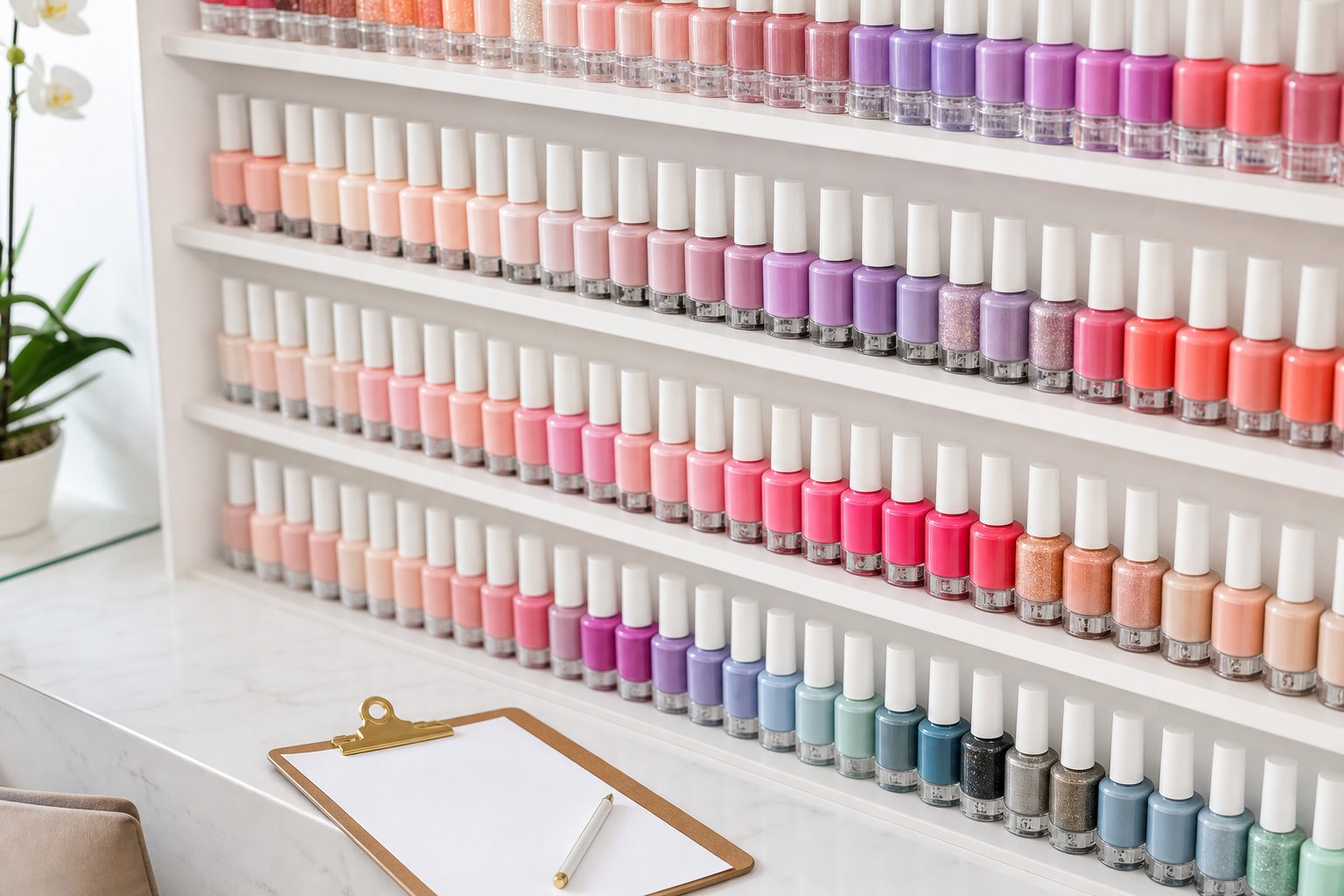
A full color wall costs more than the invoice, because most of the money sits in bottles nobody picks. The purchase price is only the first number. The one that matters is cost per bottle per use over a year, and on a typical wall that number splits into a handful of shades running under a dollar a use and a long tail running fifteen dollars or more.
This walks through one two chair studio's actual count, the arithmetic they ran on it, what they cut, and what happened to bookings afterward. The numbers below are that studio's, shared as an example, not an industry average. Run yours the same way and you will get different totals with the same shape.
The short version: they were carrying 214 bottles, 61 of them had not been used in twelve months, and cutting the wall to 148 did not cost them a single booking.
Counting the wall: bottles owned, bottles used, bottles dead
The count took an evening. Two people, a clipboard, and every bottle pulled off the shelf and put back in one of three piles.
| Category | Bottles | Share of wall |
|---|---|---|
| Gel polish, in rotation | 112 | 52% |
| Gel polish, not picked in 12 months | 44 | 21% |
| Lacquer, in rotation | 29 | 14% |
| Lacquer, not picked in 12 months | 17 | 8% |
| Separated, thickened or unusable | 12 | 6% |
| Total | 214 |
Two things surfaced immediately. First, they owned nine reds that a client would struggle to tell apart in the chair. Second, the dead pile was heavily seasonal: fall browns bought two years running, a holiday glitter set, a pastel collection from a spring promotion.
They also found duplicates. Three bottles of the same nude, bought at different times because nobody checked the shelf before ordering.
How to count without shutting down for a night
If a full stop is not realistic, count one shelf a day for two weeks. Mark each bottle with a small dot on the base when it gets used. After thirty days, undotted bottles are your candidate cut list, and you can confirm them against a full year at the next slow week.
Keep reading: What ventilation and dust control do I need if I am filing acrylic all day?
Cost per bottle divided by actual uses over twelve months
Here is the arithmetic that changed how they buy. Assume a professional gel polish bottle at $12 delivered, and roughly 40 to 60 applications in a 15 ml bottle depending on nail size and how many coats you run.
Cost per use if the bottle is fully consumed: $12 divided by 50 uses, about 24 cents. That is the best case, and it is trivial.
Now the real cases from their count.
| Shade | Bottle cost | Picks in 12 months | Cost per use |
|---|---|---|---|
| Core nude | $12 | 96, two bottles bought | $0.25 |
| Soft pink | $12 | 71 | $0.17 |
| Deep red | $12 | 34 | $0.35 |
| Mid range lilac | $12 | 9 | $1.33 |
| Fall bronze | $13 | 2 | $6.50 |
| Holiday glitter | $14 | 1 | $14.00 |
| Spring pastel, unopened | $12 | 0 | no return |
The 61 unpicked bottles represented roughly $740 in purchase cost sitting on a shelf earning nothing. That is not a catastrophe by itself. The problem is that it repeats: the same studio had bought a comparable amount of seasonal stock the year before, and most of it was in the dead pile too.
There is a second cost that never appears on an invoice. Shelf space and decision time. A client scanning 214 bottles takes longer to choose than a client scanning 148, and that browsing time is unpaid chair time. At two extra minutes per client across roughly 45 clients a week, that is 90 minutes a week of a technician standing at a wall.
Shelf life, separation and when a gel bottle is genuinely finished
Bottles do not last forever, and the failure modes differ by product.
- Gel polish generally carries a shelf life stated by the manufacturer, often around two years unopened and shorter once opened. It thickens as solvent escapes and as light exposure starts partial curing near the neck. A gel bottle with a hardened ring at the threads is on borrowed time.
- Lacquer thickens as solvent evaporates. Thinner made for that product line can revive it. Acetone cannot, it breaks the formula.
- Glitter and shimmer separate. Rolling the bottle between your palms fixes settling. If the pigment has clumped into a mass that will not disperse, it is done.
- Anything with a changed smell or a color shift gets binned, not used on a paying client.
Store the wall out of direct sun and away from the lamp station. Heat and UV both shorten gel life, and a wall in a south facing window is quietly destroying your inventory.
Disposal matters too. Polish is generally treated as hazardous waste under local rules rather than something to pour down a drain. Check your municipality's household hazardous waste guidance, since salons in many areas are directed to a specific drop off.
Keep reading: Are structured gel manicures replacing acrylic for the clients walking into my studio?
Seasonal collections: the buy that rarely earns back
Do the math before the rep's email lands. A six bottle seasonal collection at $12 each is $72. To break even against your core wall's 25 cents a use, you need those six bottles to get picked enough to justify the shelf slot, and seasonal shades have a window of roughly eight to ten weeks.
The studio's rule now: buy no more than three bottles from any seasonal drop, and only shades that could survive as a year round option. A deep berry works in October and in February. A copper glitter works for six weeks and then sits.
The alternative that worked better for them was offering seasonal looks as art rather than as base color: a core nude with a hand painted accent, charged as an add on. Art earns per client instead of per bottle, and it does not occupy shelf space in July.
Tracking picks per shade so the reorder list writes itself
Everything above depends on knowing what was actually picked. Memory is not a data source.
The minimum you need to record per appointment is the shade name or code, the product line, and the date. Three fields. From those, three questions answer themselves at the end of a quarter:
- Which shades were picked at least once a month? Those are core, keep two bottles of each.
- Which shades were picked between one and eleven times? Those are the middle, keep one bottle and do not reorder on empty without checking.
- Which were picked zero times? Cut them.
The reorder list becomes mechanical. Anything in category one that is running low gets ordered. Nothing else does, unless a client has specifically asked for it.
A useful side effect: shade history per client. When a regular sits down and you can see she has worn the same soft pink for four visits and the lilac once, you stop walking her to the wall at all. You suggest, she agrees, and you have saved the browsing minutes.
See how PolishBook handles this for nail studios
What the studio cut and what happened to bookings after
They removed 66 bottles: the 61 unpicked plus five near duplicates. The wall went from 214 to 148. The 12 unusable bottles went to hazardous waste drop off. Anything still good and simply unwanted was sold to the techs at cost or given away at a client event.
Three months later, bookings had not moved. No client asked where a shade went. Two clients commented that the wall looked easier to shop.
What did change was the ordering. In the first quarter after the cut, polish spend dropped by roughly half against the same quarter the year before, because the seasonal buys stopped and the reorders were driven by picks instead of by gaps on a shelf. Storage freed up a full cabinet, and the studio started keeping two bottles of the top six shades instead of one, which ended the mid week scramble when a core nude ran out during a busy Saturday.
The honest caveat: a studio with a heavy nail art clientele or a strong seasonal following may find its middle tier much larger. Count first. Do not cut to someone else's number.
Where to start this month
Count the wall. Put every bottle in one of three piles: picked this quarter, picked this year, not picked. Then price the not picked pile and look at the total, because that number is what makes the decision easy.
After that, the only thing standing between you and an automatic reorder list is a record of which shade went on which hand. PolishBook logs color and product used on every service alongside the client's history, so picks per shade add up on their own and the dead stock shows itself before you buy it twice.