If your booth rent goes up, the honest answer is that your gel price has to absorb the increase divided by the number of gel sets you actually perform, not the number you could perform on a perfect week. That is the whole calculation in one sentence. A fifty dollar weekly rent increase spread across twenty two real sets is about $2.27 per set. Round to three dollars and you are covered with a little room.
Most technicians do the opposite. They look at the new rent, feel the pressure, and add ten percent across a menu where the cheap services are the ones eating their time. That raises the price of your polish change more than the price of your structured gel overlay, which is backwards.
Below is the arithmetic laid out the way a booth renter actually experiences it: fixed rent, variable product, and the honest number of hours you fill in a normal week rather than a busy one.
What booth rent actually covers and what it does not
Booth rent is a fixed weekly or monthly payment for the use of a station. It does not change if you do five sets or forty. That is the crucial property, and it is why a percentage increase across your menu is the wrong instrument.
What is included varies enormously and should be in your written agreement. Common inclusions are the station, a chair, the client seat, utilities, the front door and general cleaning of shared areas. Common exclusions, which surprise people, are:
- All product: gel, base, top, primer, files, buffers, wipes, acetone.
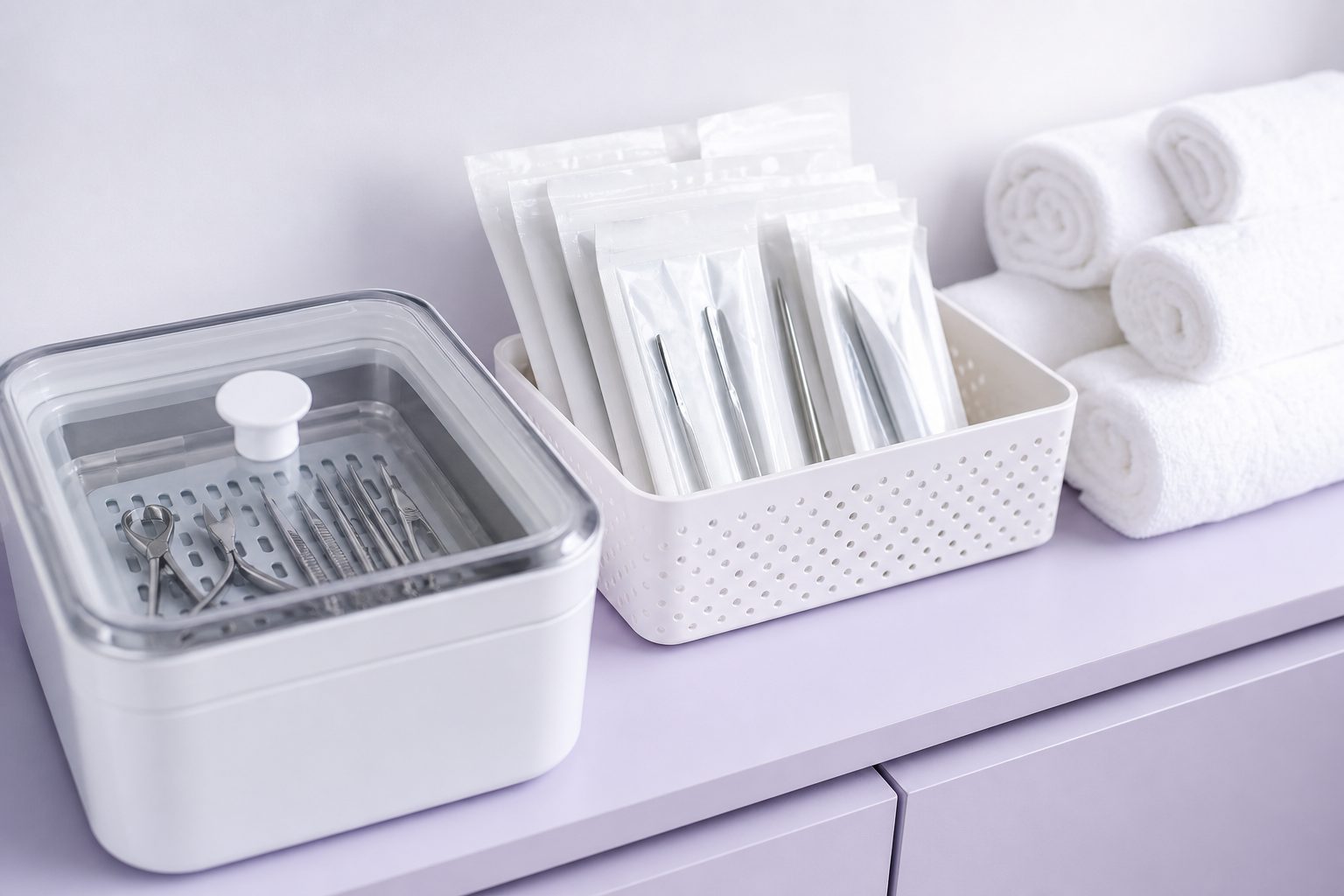
- Implements and your own disinfectant, plus the covered container it lives in.
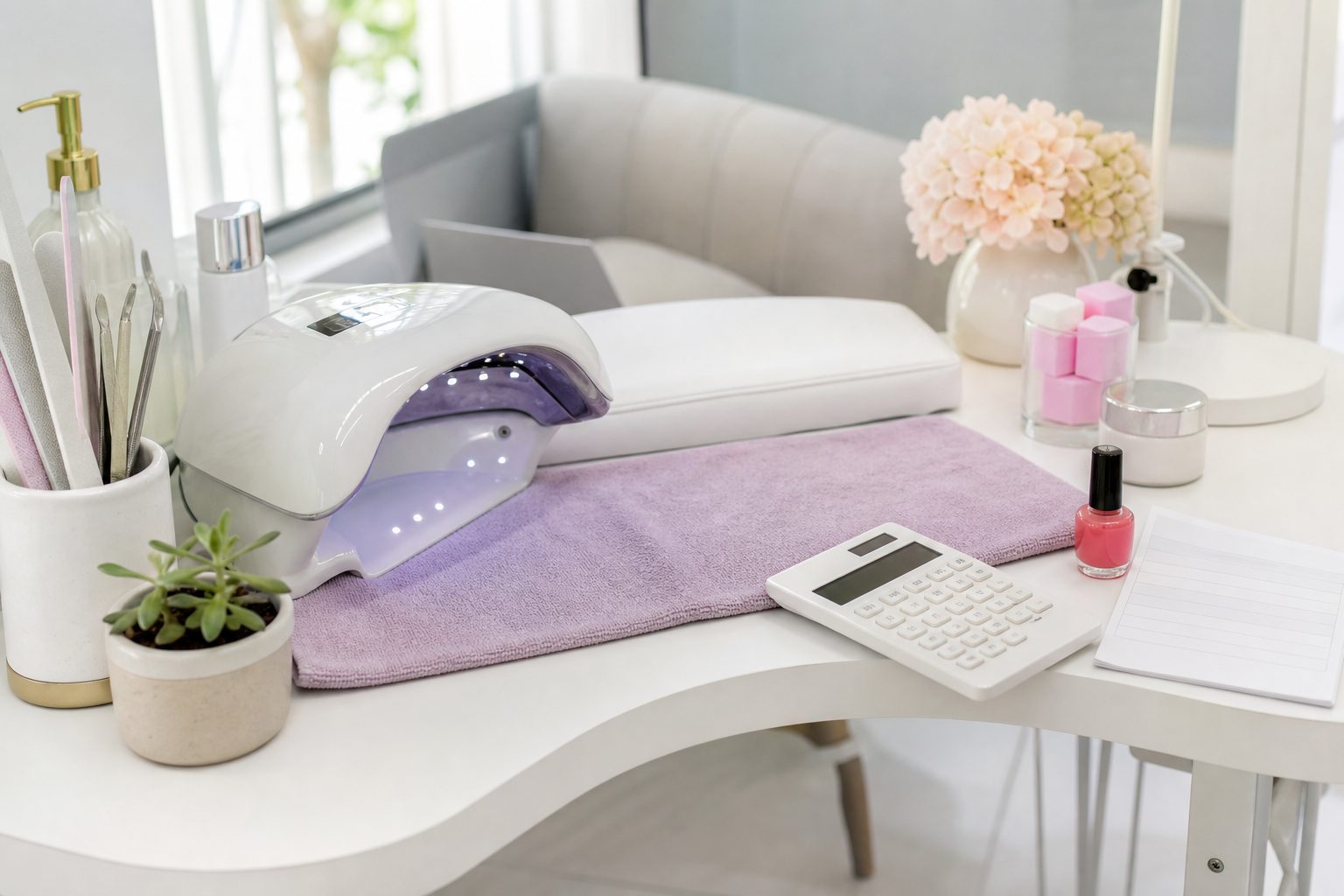
- Your lamp, and replacement bulbs or the whole unit when output drops.
- Towels and laundry, in many shops.
- Your own liability insurance and your license renewal.
- Card processing fees on every payment you take.
- Booking software, if the shop does not provide it.
As a booth renter you are typically an independent contractor, which means self employment tax on your net earnings and no withholding done for you. If you have been pricing as though your take home is your revenue minus product, you have been ignoring roughly fifteen percent off the top before income tax. Build that in now, while you are already changing numbers.
Keep reading: What does my state board actually require for sanitizing implements between clients?
Working out your true cost per gel set, product by product
Product cost per set is not a guess. It is bottle price divided by realistic sets per bottle. Do this once for your actual shelf and you never have to wonder again.
Here is a worked example. These are illustrative figures, not survey data, so substitute your own invoice prices.
| Item | Cost | Sets per unit | Cost per set |
|---|---|---|---|
| Base coat, 15 mL | $16 | 60 | $0.27 |
| Color gel, 15 mL | $14 | 45 | $0.31 |
| Top coat, 15 mL | $18 | 55 | $0.33 |
| Dehydrator and primer | $22 | 90 | $0.24 |
| Files and buffers | $1.80 each | 1 to 2 | $1.20 |
| Lint free wipes, cleanser | $0.60 | 1 | $0.60 |
| Cuticle oil, gloves, liner | $0.85 | 1 | $0.85 |
| Product total | $3.80 | ||
Now add the costs that ride on the transaction rather than the bottle. Card processing at 2.7 percent on a $65 service is $1.76. Bulb depreciation, if a $90 lamp is replaced every eighteen months over roughly 1,400 sets, is about $0.06. Laundry, if you wash your own towels, might be $0.35 a client.
Call it $6 per set, all in, before rent and before your time. That number is boringly small compared to rent, which is exactly the point.
Break even hours: how many sets pay the rent before you earn
Take your monthly rent and divide by your contribution per set, which is price minus product and transaction cost. That tells you how many sets are pure rent coverage.
Assume rent of $250 a week, a gel set at $65, and $6 of cost. Contribution is $59. Rent divided by contribution is 250 divided by 59, which is 4.24 sets. So a little over four gel sets a week go entirely to the landlord before you are paid anything.
Now raise rent to $300. Break even becomes 5.08 sets. You have handed over most of another appointment slot. If a gel set takes seventy five minutes with turnover, that is an extra hour a week worked for nothing.
The recovery calculation is simple. New rent minus old rent, divided by your honest weekly set count:
- Count gel sets on four ordinary recent weeks, not your best week. Say 88 total, so 22 a week.
- Rent increase is $50 a week.
- $50 divided by 22 equals $2.27 per set.
- Round up, because the count will dip in a slow month. Add $3.
If you want the increase to also cover self employment tax on the new revenue, divide by roughly 0.85 first. $2.27 divided by 0.85 is $2.67, still inside a $3 round up. That is the whole exercise.
Keep reading: Why do my gel sets lift at the cuticle on some clients but never on others?
Why a flat dollar increase beats a percentage bump on a short menu
Rent is a flat cost, so it should be recovered flatly. A percentage increase recovers more from your expensive services and less from your cheap ones, which is the reverse of how time is consumed. A polish change and a full gel set may differ by forty dollars in price but only forty minutes in time.
Compare the two approaches on a five percent bump versus a flat $3:
| Service | Old price | Plus 5 percent | Plus $3 flat |
|---|---|---|---|
| Polish change | $25 | $26.25 | $28 |
| Gel manicure | $65 | $68.25 | $68 |
| Gel with removal | $80 | $84 | $83 |
| Structured overlay | $95 | $99.75 | $98 |
The flat version lands on clean numbers, is easy to explain, and pulls the most from the short service that has been quietly underpriced. A percentage version produces $68.25 and $99.75, which nobody wants to write on a menu, and undercharges the polish change that still costs you a full station turnover.
The one case for a percentage is a long, deep menu with a wide price spread, where a flat dollar figure would be trivial on the high end. Most booth renters do not have that menu.
Repricing add ons: nail art, soak off, and structured overlay
Add ons are where margin quietly leaks, because they consume time that never got priced. Fix them by the minute, separately from the rent recovery.
Soak off and removal
Removal of your own work is fast and low risk. Removal of another technician's builder gel, hard gel or dip is slow and unpredictable. Price them differently. A reasonable structure is removal of your own set included or five dollars, and foreign removal at fifteen to twenty five depending on what you find. Say out loud at booking that foreign removal is quoted at the chair.
Nail art
Charge per nail, not per set, and set a tier ceiling. Simple line work or a single accent at three to five dollars a nail. Detailed hand painting, chrome, encapsulation or 3D at eight to fifteen. A ten nail chrome set is then a defined forty to sixty dollar add on rather than a favor you did for free at the end of a long appointment.
Structured overlay
This is the one clients most often expect for the price of a regular gel manicure. It uses builder gel, adds apex work, and typically adds twenty to thirty minutes. Price it as its own line item, not as a discreet upgrade, and note in the client record who has had it, because that is the client who will assume it is standard next time.
See how PolishBook handles this for nail studios
Telling regulars about a price change without losing the book
Notice, plain language, and no apology. Three to four weeks of warning is standard and respectful, delivered at the chair to anyone you see in that window and by message to everyone else.
What works, in order:
- Say it in person first to your highest frequency clients. They should not hear it from a text.
- Give a date. "Starting March 3, gel is $68." Not "in the new year".
- Honor the old price for anything already booked before the date. It costs you very little and buys real goodwill.
- Do not explain your rent. Clients do not price your business, and a costs explanation invites negotiation. One line is enough.
- Pair the change with something visible: a new top coat that holds shine longer, a better cuticle oil sent home, cleaner turnaround.
Expect to lose a small number of clients, mostly the ones who already stretched four weeks to six and rebooked erratically. Losing a client whose contribution was $59 hurts less than working an extra unpaid hour every week forever.
Where to keep the numbers so the next increase is easy
The hard part of this exercise is not the math. It is knowing how many gel sets you really did last month, which clients take an extra twenty minutes, and who is on structured overlay at a plain gel price. If that lives in your memory, you will guess next time too.
PolishBook keeps service and color history per client, along with how long each set actually wore and what product went on it, so your set counts, your add on frequency and your rebooking intervals are already recorded when the rent letter arrives. Pull the last four weeks, divide, and set the new number the same afternoon.