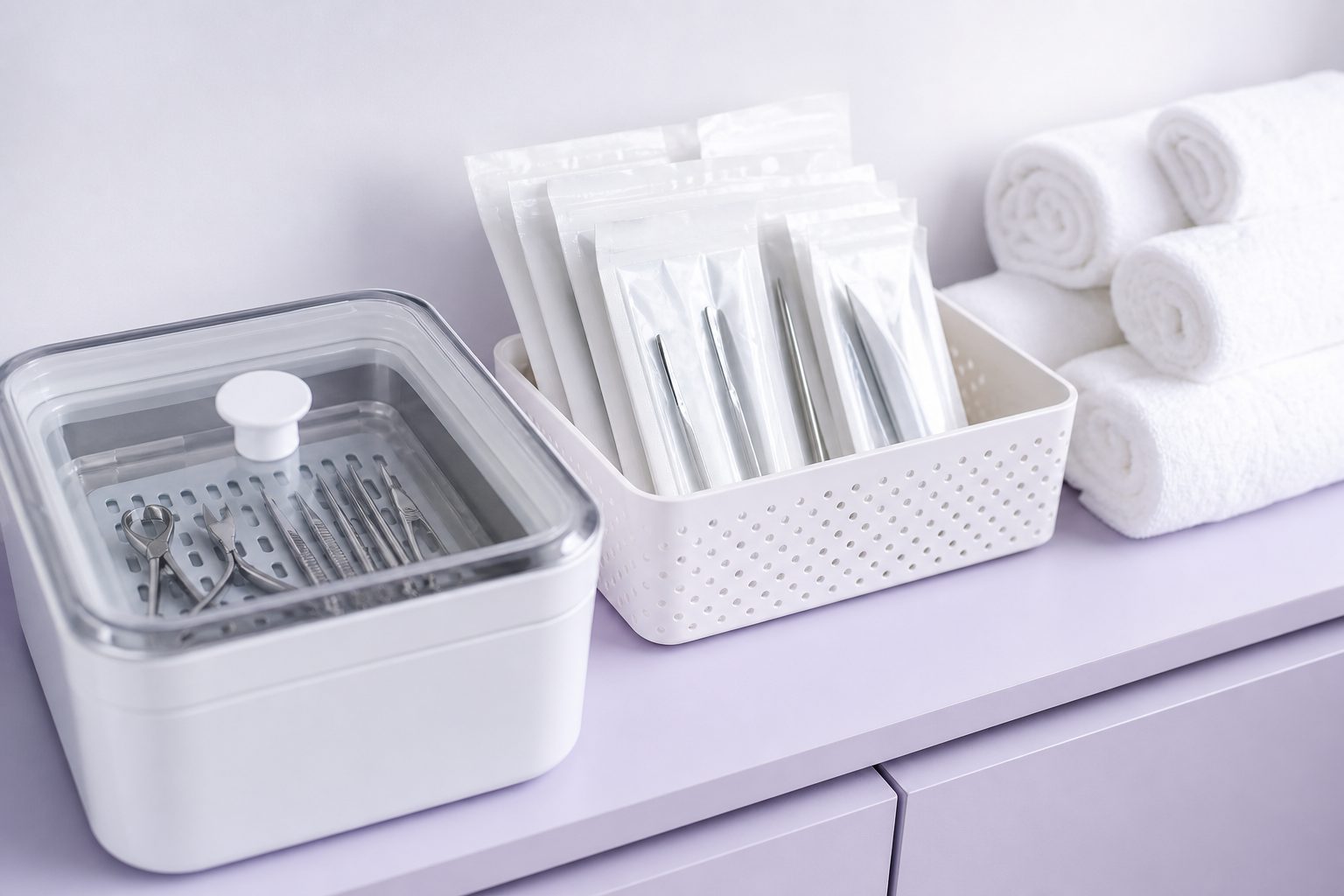
Your board almost certainly requires a three step sequence on every reusable implement: wash it clean of visible debris, immerse it fully in an EPA registered hospital grade disinfectant for that product's full labeled contact time, then dry it and store it in a covered, clean, closed container separated from anything used. Anything porous, anything that cannot survive full immersion, and anything that touched blood is single use and goes in the trash.
The details vary by state: which disinfectant categories are named, how long solution may stay in the jar, whether foot spas need a weekly overnight protocol, what the log must show. The structure does not vary. If you build your station around that three step sequence, you are compliant almost everywhere and you only have to check your own state for the specifics.
Here is what each step actually means, where the citations concentrate, and how to find your state's current rule text rather than a repost of a rule from six years ago.
Clean versus disinfect versus sterilize, and why boards separate them
These are three different levels and boards treat them as three different obligations.
Cleaning is physical removal of debris, oil, dust and product residue with soap and water and a brush. It does not kill anything reliably. It exists because disinfectant cannot penetrate a film of gel dust and cuticle oil. Skipping the scrub does not just weaken the disinfection step, it voids it, because every hospital grade product's label assumes a precleaned surface.
Disinfection kills the pathogens named on the product label at the concentration and contact time on that label. Hospital grade means the label carries bactericidal, virucidal and fungicidal claims. This is the level nearly every state requires for nippers, pushers, tweezers and metal files.
Sterilization destroys all microbial life including spores, and in a salon means an autoclave with validated cycles and spore testing. Most state boards do not require it for standard nail services. Some allow or require it if you perform services that are likely to break the skin. If you run an autoclave, you inherit the whole compliance package: pouches with indicators, cycle logs, and periodic biological spore testing through a mail in service.
Where technicians get caught out is assuming an ultraviolet cabinet or a bead sterilizer covers them. UV boxes are storage, not disinfection, in the eyes of most boards, and several explicitly say so. A bead sterilizer heats only the tip that is inserted, not the handle or the joint.
Keep reading: Why do my gel sets lift at the cuticle on some clients but never on others?
EPA registered hospital grade disinfectants and reading the contact time
The product must carry an EPA registration number on the label. That number is your proof, and an inspector may ask to see the original labeled container rather than a decanted jar.
Read four things off the label before you buy:
- Registration number. Present, legible, and on the container you actually keep.
- Claims. Bactericidal, virucidal, fungicidal at minimum. Tuberculocidal is required by some states for certain uses.
- Dilution. Concentrates are usually given as an ounce per gallon ratio. Mixing by eye is the most common way people run a solution that is legally and practically useless.
- Contact time. Typically ten minutes for immersion products, but some are shorter and some sprays require the surface to stay visibly wet for a full ten minutes, which a single spray pass will not achieve.
Contact time is a floor, not a target. A nipper dipped and pulled out after ninety seconds because the next client is in the chair has been rinsed, not disinfected. The practical answer is inventory: own three sets of nippers and pushers so one set can sit in solution for its full time while you work.
Solution must be changed on the schedule the label states, and immediately whenever it becomes cloudy, visibly contaminated, or has debris settled at the bottom. Many boards additionally require a daily change regardless of appearance.
Single use items your board will not let you reuse
The test is porosity. If a surface absorbs liquid, it cannot be disinfected, because disinfectant cannot reach through it and it cannot be rinsed clean. That means these are one client, then discarded:
- Wooden orangewood sticks and cuticle pushers.
- Emery boards, buffer blocks and any file with a paper, foam or cardboard core.
- Toe separators of foam, and disposable slippers.
- Pumice stones and pumice bars.
- Cotton, wipes, sponges, gauze, paper liners.
- Drill bits are the exception people get wrong: carbide and diamond bits are non porous and may be cleaned and disinfected, but sanding bands and mandrel sleeves are single use.
Metal files, glass files, stainless implements, chrome pushers and reusable bit sets are all non porous and go through the three step process.
Anything that contacts blood is discarded, without exception, even if it is metal in some states. Know your state's blood exposure rule before you need it, and keep the response supplies on hand: gloves, an antiseptic, an adhesive bandage, and a sealed sharps or biohazard bag.
Keep reading: Should I rent a booth, sublease a suite, or hire techs as W2 employees this year?
Pedicure bowl and jet protocols, the most cited violation category
If your shop offers pedicures, foot spas are where inspectors look first and where the highest volume of citations are written. The reason is mechanical: any unit that circulates water through pipes, jets or an impeller has interior surfaces you cannot see or scrub, and biofilm grows there.
The typical required regimen has three tiers.
After every client
Drain the water. Remove and scrub the screen, filter, jet or impeller assembly. Clean the bowl surface with soap. Refill with water and the correct dose of disinfectant, and circulate it for the labeled contact time, then drain and wipe dry.
End of every day
Repeat the above, then remove the screen and clean underneath it, and in many states circulate a chelating or low sudsing cleaner before the disinfectant.
Weekly
Fill, add disinfectant, circulate briefly, then turn the unit off and let the solution sit in the lines overnight, or for the period your state names. Drain and flush in the morning. This is the step that removes accumulated biofilm and the step most often skipped.
Pipeless units are easier but not exempt. The impeller assembly comes out and gets cleaned, every single time. A liner in a jetted tub does not replace the protocol either, unless your board says so in writing.
Logs, labeling and dated solution changes an inspector can ask to see
An inspector cannot watch you disinfect. What they can do is read your records and check whether the physical evidence matches. Keep it simple and keep it current.
| Record | What it shows | Typical retention |
|---|---|---|
| Foot spa cleaning log | Date, time, unit, which cleaning tier, initials | 60 days to 2 years, varies by state |
| Disinfectant change log | Date solution mixed, product, dilution | Current period |
| Original product labels | EPA number and directions | While in use |
| Autoclave cycle and spore test | Cycle date, result of biological indicator | Only if you sterilize |
| Licenses and posting | Your license and the shop license, displayed | Always visible |
Labeling matters as much as logging. Containers holding a mixed solution should be labeled with the product name and the date mixed. Clean and used implements need visibly separate, covered, labeled storage. A drawer with both in it reads as a single violation no matter how careful you actually were.
A practical station setup that survives an unannounced visit: one covered disinfection container with the label facing out, one closed drawer marked clean, one closed bin marked to be cleaned, a lidded trash can, and a clipboard or a phone record for the logs.
See how PolishBook handles this for nail studios
Where your state rules live and how to check the current version
Do not rely on a training handout, a supplier flyer, or a post in a technician group. Rules change, and the version circulating socially is often out of date.
- Search for your state's board of cosmetology, barbering or its combined licensing agency. Some states run it through a department of licensing or a department of health rather than a standalone board.
- Find the administrative code or rules section, not the FAQ page. That is the enforceable text.
- Read the sanitation, infection control and salon requirements sections in full. They are usually a handful of pages.
- Look for the inspection sheet or violation checklist. Many boards publish the exact form the inspector fills in, which is the most useful single document you will find.
- Check the meeting minutes or rule change notices once or twice a year, and any time a supplier tells you a rule changed.
- Print the current sanitation section and keep a copy in the shop. If a disagreement comes up about protocol, the text settles it.
If you rent a booth, the shop's license and your license are separate obligations. Shared area violations may land on the owner while station violations land on you. Read your rental agreement for who is responsible for the foot spas.
Making the routine survive a busy day
Compliance fails on the fifth client of a full Saturday, not on a quiet Tuesday. The fix is structural: enough implement sets to respect contact time, a labeled container that is always in the same place, and logs recorded at the moment rather than reconstructed at closing.
PolishBook holds the working record of each client alongside the service you performed and the products you used, so when a client asks what went on her nails, or when you need to reconstruct which day and which technician handled a set, the answer is one tap away instead of a memory test. Keep the compliance logs where the board requires, and keep the client detail where you can find it.