You inspect before you speak. A nail that broke seven days after a full set tells you what happened if you look at the break line, the free edge thickness and the apex, and that reading determines whether you are looking at a service failure you should fix for free or physical trauma you can fix for a fee.
The mistake almost everyone makes is answering the emotional question first. She says "my nails broke." You say "come in, let me look," and nothing else. No apology that concedes fault, no defense that sounds like blame. You have not seen the nail yet.
What follows is the inspection sequence, the physical tells that separate a lifting failure from a slammed car door, and a fix window policy you can post and apply the same way every time.
What to look for on the damaged nail before you say anything
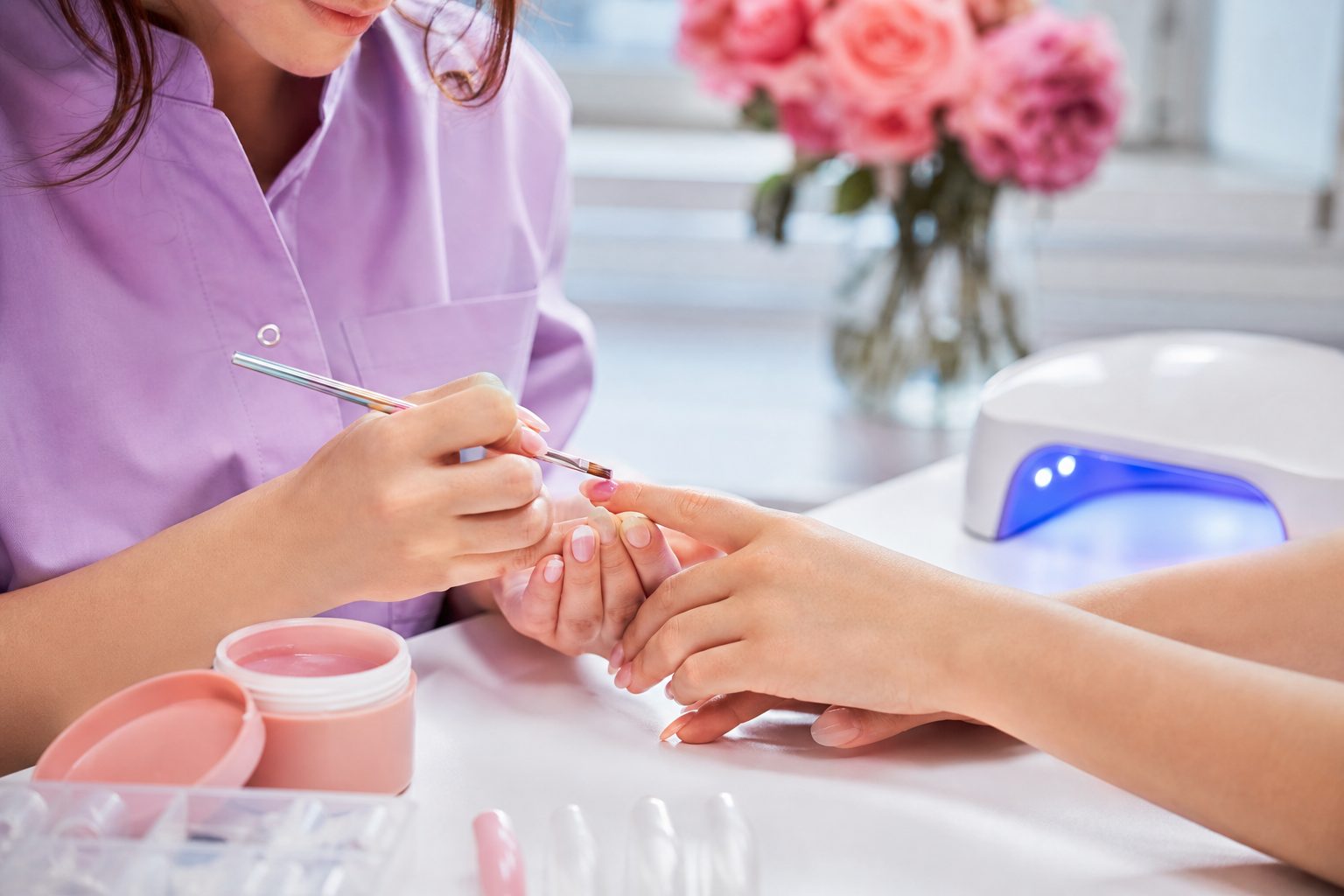
Seat her at the desk under the lamp. Ask her to put both hands flat. Look at all ten, not just the one she is upset about, because the pattern across the set is the diagnosis.
Work through this in order:
- Is the natural nail plate damaged, or only the enhancement? If the product left cleanly and the plate underneath is intact and smooth, adhesion failed. If the plate is torn or the break runs into the nail bed, force was applied.
- Where is the break? A break at the stress area, just past the smile line, points to a thin apex. A break at the free edge points to length and impact.
- How thick is the product at the break? Look at the cross section. Paper thin at the apex is a build problem.
- Is there lifting at the cuticle area on the other nails? Lifting on three or four fingers is a prep or product issue across the whole set.
- How much regrowth is showing? A week of growth is about a quarter of a millimeter. If you are looking at two millimeters, this set is closer to three weeks old than seven days.
- Is there green or dark discoloration under the product? That changes the conversation entirely. It becomes a removal and a referral, never a rebalance over the top.
Say what you see out loud while you look. "The plate under this one is smooth, so the product released rather than tearing." Clients calm down when they hear a technician thinking instead of negotiating.
Keep reading: What does it really cost me to keep a full color wall stocked and current?
Service breakdown versus trauma: the physical differences
These two look different under a lamp once you know what you are comparing.
| Sign | Points to service breakdown | Points to trauma |
|---|---|---|
| Number of nails affected | Several, often the same fingers on both hands | One, occasionally two adjacent |
| Break edge | Clean release, product lifts as a shell | Jagged, splintered, often bloodied |
| Nail plate underneath | Intact, sometimes with visible oil or moisture | Torn, split, or lifted from the bed |
| Location | Cuticle area or sidewall lifting first | Free edge or stress area, sudden |
| Timing she reports | Gradual, "it started peeling" | Sudden, "it caught on something" |
| Pattern with her habits | Dominant hand no worse than the other | Dominant hand or index finger worse |
Common service causes: oil or dust left on the plate before product, product applied onto the skin so it lifted from the edge, cured too thin at the apex, a gel top coat that did not fully cure because a lamp bulb is aging, or a mismatch between the client's nail shape and the length she asked for.
Common trauma causes: opening a soda can, a car door, gardening, gym bars, a new job with keyboard impact, or filing at home with a coarse file. Also relevant: a new medication or a pregnancy can change the plate, and acetone based products at home can soften an enhancement from the surface down.
The one that is genuinely mixed
Length. If she asked for an extra quarter inch beyond what her natural nail can support and you built it, that break is partly a structural decision you both made. This is where you say, at the fix, that you are shortening to a length the set can carry, and why.
Writing a fix window policy and where to post it
A policy stops you from making a new decision under pressure every time. Write it in three sentences and stop.
A workable version: Repairs are free within seven days of your service for one or two nails. From day eight, repairs are charged at the per nail rate. Breaks caused by impact or by filing at home are charged at any time.
Post it in four places, because clients will only ever see one of them: on the booking confirmation, on the service menu page, on a small card at your station, and in the appointment reminder text. If a client disputes the charge and you can show that it appeared in her own booking confirmation, the conversation ends quickly.
Set the window to match your service. A seven day window is common for acrylic and hard gel. If you do a lot of soft gel overlays on short natural nails, five days is more honest. Whatever you pick, do not change it per client.
Keep reading: What ventilation and dust control do I need if I am filing acrylic all day?
When a free repair is correct and when a paid one is
Here is a decision rule you can apply in thirty seconds at the desk.
- Free repair, no discussion: lifting on three or more nails within the window, product released cleanly with an intact plate, or a visible cure or prep failure. This is your work and fixing it fast is cheaper than the review.
- Free repair, with a note: a single break inside the window with an intact plate and a thin apex. Fix it, log that you thinned the apex on that finger, and adjust the build next time.
- Paid repair: a torn plate, a jagged break, a single nail on the dominant index, or any break after the window. Charge the per nail rate.
- Removal and referral, never a repair: green discoloration, pain, swelling, or a lifted nail bed. Remove the product, do not reapply, and tell her to see a doctor. Note it in her record.
- Full redo at no charge: more than half the set failed inside the window. That is rare and it is a signal to check your lamp, your primer date and your prep routine before you touch anyone else.
Price the paid repair so it covers your chair time, not your product. A single nail repair takes fifteen to twenty minutes with cleanup. If your hourly target is $75, a $20 repair is roughly break even and reads as reasonable. Charging $8 trains clients to break nails.
Documenting the original service so you can compare wear time
You cannot argue about wear time from memory. You need the record of what you actually did.
The fields that settle disputes are short:
- Service date and service type, acrylic full set, hard gel fill, soft gel overlay.
- Product line and shade, including base and top coat, plus lot if you have had a bad batch before.
- Length and shape as done, not as requested.
- Prep notes: dehydrator used, primer used, any oil or lifting seen on arrival.
- Anything the client mentioned: new job, gym, gardening, medication change.
- Wear time from the previous set, which is the single most useful number you own.
That last one is the difference between guessing and knowing. If her last four sets ran nineteen, twenty one, eighteen and twenty days and this one failed at seven, something changed and you should find it. If her sets have always failed around day eight, the length and shape you are building do not match her hands, and that is a consultation, not a repair.
See how PolishBook handles this for nail studios
Handling the complaint that arrives as a public review instead
Sometimes the first you hear of it is one star online. Respond, once, in public, in three short lines. Thank her for the feedback, state your fix window as a policy rather than a defense, and invite her to book a repair appointment. Do not describe her nails, her habits or her history in public. Never mention what she paid.
Something like: Thank you for telling me. My policy is a free repair within seven days for one or two nails, and I would like to take a look at yours. Please book any opening this week and ask for a repair slot.
Then take the rest to direct message or phone. If she comes in, follow the same inspection sequence you would for anyone. If the review was unfair and she never responds, leave it. One measured public reply does more for the next reader than a long argument does.
Making it routine
The whole approach rests on two things: a policy you never bend, and a record you can pull up while she is sitting there. Write the policy this week and put it on your booking confirmation.
For the record, PolishBook holds service and color history per client with wear time notes and the product used on each set, so when someone says her nails broke early you can see in one tap what she wore, how long her last three sets lasted and what you built. That turns a disagreement into a diagnosis, which is the only version of this conversation that keeps the client.