Partly, and not evenly. Structured gel has clearly taken share from liquid and powder for the client who wants length, a natural look and a removal appointment that does not involve twenty minutes of foil and acetone. In a lot of urban and suburban studios, builder gel and gel extensions now carry more of the extension book than acrylic does.
What has not happened is acrylic disappearing. It still owns the long dramatic shapes, the heavy nail art builds, the clients with aggressive lifestyles who break gel, and the fill schedule that keeps a book profitable. If you drop acrylic from your skill set because the trend feels one directional, you will lose the exact clients who pay the most per visit.
The honest read is that the menu has split. Most studios doing well right now offer both, price them differently, and steer each client to the system that suits her nails and her habits. Here is what changed, why, and what it costs you to add.
What structured gel, builder in a bottle and gel x actually are
All three are gels, meaning they cure under UV or LED light rather than air drying through a chemical reaction between a liquid and a powder. The differences are in viscosity, packaging and how the length is created.
Structured gel manicure usually means a thicker gel built into an apex over the natural nail, with no extension. It reinforces a weak plate and gives the arch that makes a manicure look expensive. No tip, no form, no added length.
Builder in a bottle is a thick gel packaged in a polish style bottle with a brush in the cap. It is the same family as a potted hard gel, just easier to handle. Techs use it for overlays, for short extensions on a form, and for reinforcing an apex.
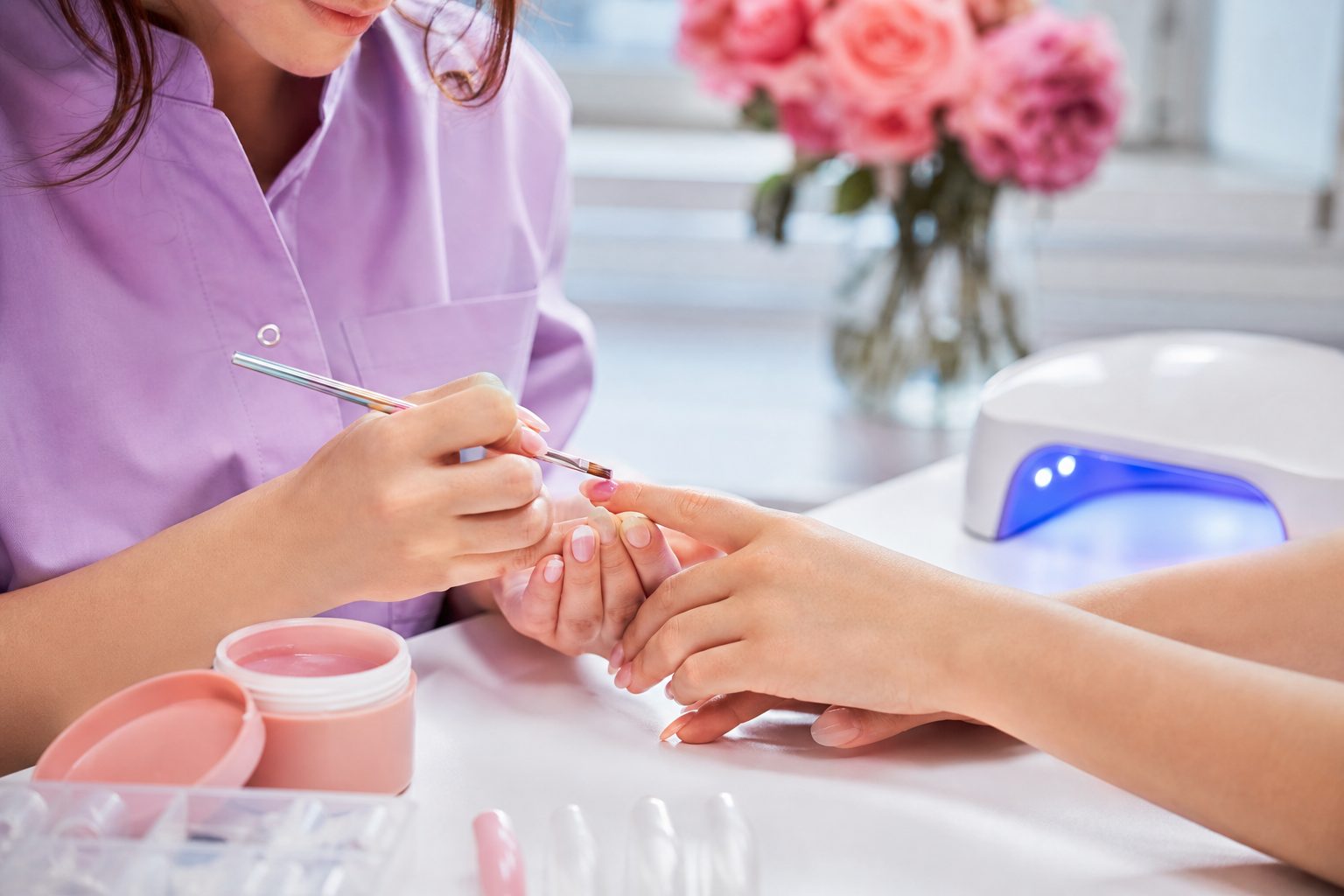
Gel x and soft gel extensions describe a full cover soft gel tip, sized to the nail, adhered with a gel adhesive and cured. The tip is pre shaped, so the sidewall and apex are largely built into the product rather than filed by you. That is why the service is fast and why it dissolves in acetone.
The important technical divide is not gel versus acrylic. It is soluble versus not soluble. Soft gel tips and most gel adhesives break down in acetone. Traditional hard gel does not, and has to be filed off. Liquid and powder acrylic soaks off, though slowly. Know which you are applying, because it determines the removal appointment you owe the client months later.
Keep reading: How long should I actually block for a full set with art if I am running solo?
Why clients ask for them: removal, odor and nail plate damage
Three complaints drive the request, and they come in this order.
Removal. A client who has had a bad acrylic removal remembers it. She remembers the e file, the heat, the thinned nail plate underneath, and the tech who was in a hurry. Soft gel removal is genuinely gentler and shorter, and she has heard so on social.
Odor. Monomer has a strong, unmistakable smell. Clients who work in offices, who are pregnant, or who simply do not want to carry the smell home ask for the option without it. Gels are not odorless, but they do not announce themselves down the hallway.
Damage. This one is mostly misattributed. Acrylic does not damage the nail plate. Bad prep, over filing and forced removal damage the nail plate, and those happen with gel too. But the belief is out there, and arguing with it at the desk loses you the booking. Better to explain what you actually do differently: minimal buffing, no drilling to the natural nail, soak rather than pry.
Chemistry differences that change your prep and your fill schedule
Acrylic cures by polymerization the moment the monomer wets the polymer bead. It sets on your timeline, so your bead control and placement are everything. Gel does not cure until the lamp turns on, which means you can move it, level it and flip the hand to let gravity build your apex before you cure. That single difference is why techs who switch report that gel feels forgiving and slow, and why gel work that looks fine wet can cure into a flat, shapeless overlay if you never learned to control the float.
Prep changes too. Gel is less tolerant of oil and moisture at the interface than acrylic. Dehydrate properly, use a primer matched to the system rather than whatever primer is on the shelf, and never mix brands across a bond line unless the manufacturer says the systems are compatible. A large share of the lifting complaints in gel work trace back to a bonder from one line under a builder from another.
Cure is the other variable. Wattage, lamp age and how the fingers sit in the chamber all affect it. A gel that looks hard on top can be under cured underneath, which shows up two weeks later as a service breakdown and, worse, as a contact allergy risk from uncured monomers touching skin. Use the lamp the manufacturer specifies, and replace lamp bulbs on schedule if yours are the replaceable kind.
Fill intervals
Both systems grow out at the same rate, because that is the nail, not the product. What differs is the rebalance work. Acrylic fills involve reducing the old product, refilling the regrowth area and rebuilding the apex. Gel fills are similar in principle, though soft gel tip sets are more often removed and reapplied as a whole rather than filled, which changes both your timing and your pricing.
Keep reading: How much should I charge for a gel manicure when my booth rent goes up?
Service time and product cost compared with liquid and powder
The trade off is real, and you should put numbers on it for your own studio rather than accepting anyone's averages. Here is a worked comparison with assumptions stated plainly. Substitute your own.
| Liquid and powder full set | Gel x full set | Builder gel overlay | |
|---|---|---|---|
| Assumed chair time | 120 min | 85 min | 75 min |
| Assumed product cost | $5 | $9 | $6 |
| Assumed price | $95 | $85 | $70 |
| Gross per set | $90 | $76 | $64 |
| Gross per chair hour | $45 | $54 | $51 |
Those are assumptions, not findings. Change the chair time by fifteen minutes and the ranking moves. The reason the gel column often wins anyway is the pre shaped tip: a large part of the shaping labor was done in a factory, and you are paying for it in the tip cost rather than in your own hands.
Where acrylic pulls ahead is at length and at complexity. A long tapered square with a sculpted C curve is faster in acrylic for most experienced techs, and it holds a heavier art build without flexing. Price your long sets accordingly.
The acrylic work that is not going anywhere
Keep the liquid and powder skills sharp for these:
- Extreme length and sculpted shapes. Duckbill, extra long stiletto, anything sculpted on a form beyond a tip's range.
- Encapsulation. Glitter, foil, dried flowers and 3D work sealed inside the enhancement.
- Repairs and rebuilds. A cracked corner rebuilt in acrylic and blended is fast and strong.
- Clients who work with their hands. Nurses, cooks, warehouse staff, anyone who is hard on nails. Acrylic's rigidity is a feature for them.
- Price sensitive fill books. Fills are the backbone of a steady weekly income, and acrylic fills are the most efficient version of that.
A studio that offers only gel gives that work to someone else.
See how PolishBook handles this for nail studios
Retraining, practice hands and how to add the service without dropping quality
Adding a system to a live book goes wrong when you learn on paying clients. Do it in this order.
- Pick one system and one brand. Buy the bonder, the builder, the tips, the adhesive and the top coat from that line. Do not mix.
- Take the brand's education if it exists. Manufacturer classes teach the specific cure times and prep their chemistry expects, which is where most self taught gel work fails.
- Work through at least ten full sets on a practice hand before touching a client. Focus on apex placement and on cuticle area thinness, which is where gel gives itself away.
- Offer it free or heavily discounted to five regulars who will tell you the truth, and book them for a two week check.
- Time yourself on all five. Set your booking block from your own real numbers, not the class's.
- Check them at two and four weeks. Lifting at the cuticle means prep. Lifting at the free edge means over filing or capping. Cracks mean apex placement.
- Only then put it on the menu, priced from your measured chair time.
Budget for the shift honestly. A single brand starter kit, a compliant lamp, a tip box range and practice hands is a real number, and it will take a handful of full price sets to earn back.
Where to start on Monday
You do not need a market forecast to decide this. You need to know what your own clients are already doing. Pull the last six months of your book and ask three questions: how many clients asked about gel extensions by name, how many acrylic clients complained about removal or smell, and how long each client's set actually lasted before she came back.
That last one is the number nobody has, because it lives in memory rather than in a record. PolishBook keeps service and color history per client with wear time notes and product usage, so when she sits down you can see what she wore, how long it held and what she is due for next. Once you can see which sets are breaking at two weeks and which are holding at four, the question of which system to push stops being a trend argument and becomes a decision you can make from your own floor.