If you are filing acrylic all day, you need three things working together: capture at the table where the dust and vapor are made, a respirator on your face rated for fine particulate, and enough air movement in the room to clear what escapes the first two. Room air purifiers alone are the weakest of the three, and they are the one most studios buy first.
The order matters because the exposures behave differently. Acrylic dust is a solid particle, and much of it stays airborne long after you stop filing. Monomer vapor is a gas, and no particulate filter touches it. One box on the wall cannot solve both.
Here is the practical version: capture at the source, cover everything that can evaporate, wear the right mask, change your filters on a schedule you actually keep, and keep your safety data sheets somewhere a person could find them in under a minute. That is the whole program. The detail below is how to do each part without spending money on equipment that will not help.
Source capture at the table versus room air cleaners
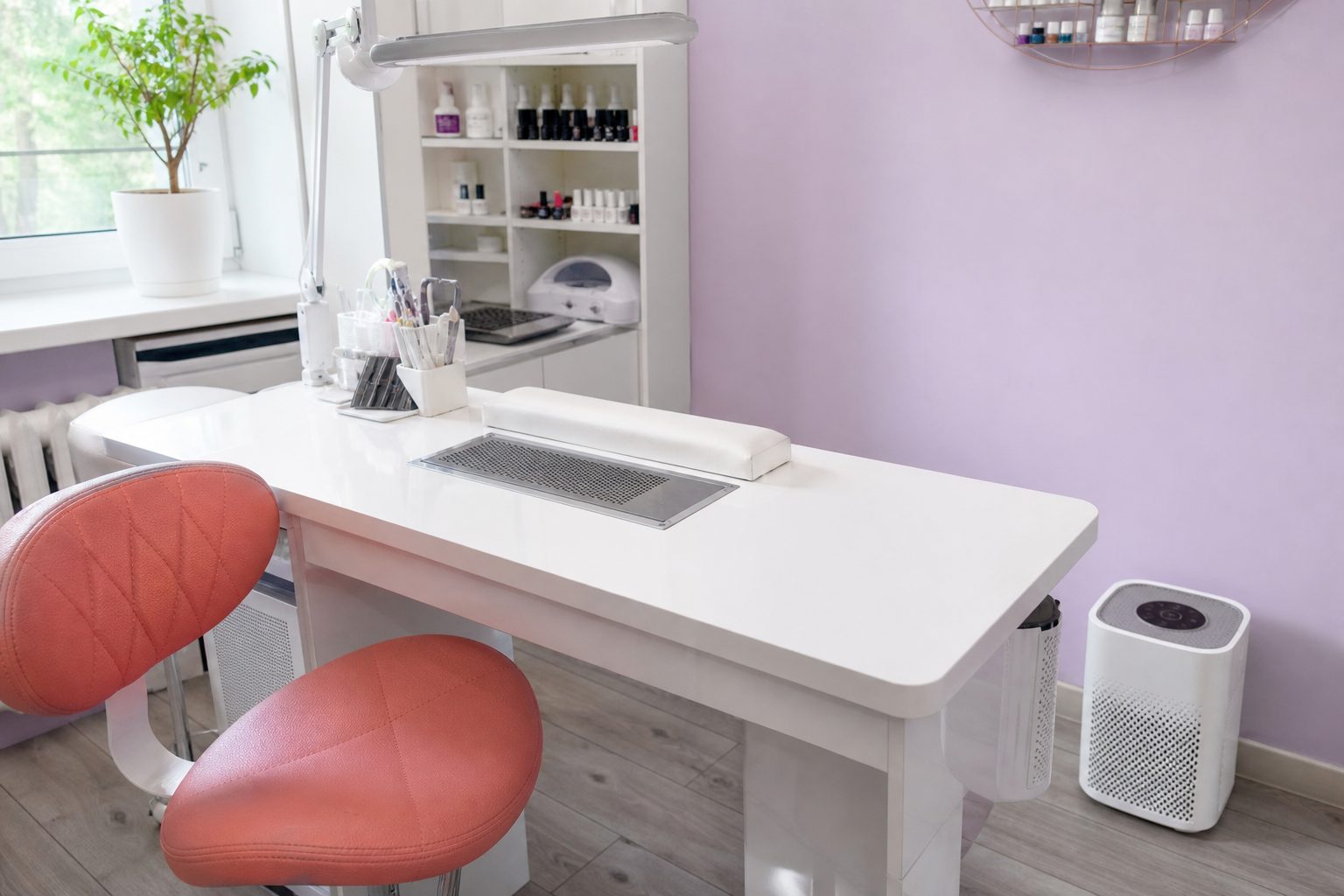
Source capture means pulling the contaminated air away at the point where it is generated, before it reaches your face. That is a vented table, a small extractor arm positioned near the hand, or a downdraft manicure table with the intake right under the working area. Room air cleaning means filtering air that has already mixed with the room, which by definition means it already passed through your breathing zone.
That said, a room unit still earns its place as the second layer. Fine dust drifts, clients kick it up when they move their hands, and no capture point is perfect. Pick a purifier with a true HEPA element and, importantly, a real activated carbon bed, not a thin carbon coated pad, if you want it doing anything at all about monomer odor. Carbon volume is what matters for gases. A quarter inch of gray fabric is decoration.
Sizing a room unit honestly
Manufacturers publish a clean air delivery rate, usually in cubic feet per minute. To convert that into air changes per hour in your space, take the room volume, then work out how many times per hour the unit could theoretically process it.
Assume a 12 by 15 foot room with 9 foot ceilings. That is 1,620 cubic feet. A unit moving 250 cubic feet per minute delivers 15,000 cubic feet per hour, which is about 9 air changes. That number is idealized: real rooms have dead corners, and most people run these units on the quiet setting rather than the setting the rating was measured at. Treat it as a ceiling and buy more capacity than the box says you need.
Keep reading: Are structured gel manicures replacing acrylic for the clients walking into my studio?
What a downdraft table actually removes and what it misses
A downdraft table with the intake grille directly beneath the client's hand does an excellent job on filing dust. Dust is heavy, it falls, and the intake is exactly where gravity is already sending it. This is the single best return on money in the whole ventilation conversation.
What it misses is anything that rises. Monomer vapor from an open dappen dish drifts upward and outward, not down. So does the vapor coming off a brush you just wiped. A downdraft intake several inches below the source is fighting the direction the vapor wants to go.
The fix is not a bigger table. It is capping and covering, plus an extractor positioned near the hand rather than under it if your work is monomer heavy.
Ducted versus filtered
Vented tables come in two designs. A ducted table exhausts outdoors through a wall or window, which removes the contaminant from the building entirely. A filtered table pushes air through a cartridge and returns it to the room, which removes it only as well as the cartridge performs, and only until the cartridge loads up.
Ducted is better, and if your lease allows a wall penetration it is worth the install. A filtered table is a reasonable second choice, but its performance is a straight function of whether you change cartridges.
Choosing a respirator rating that handles fine acrylic dust
A surgical mask is not respiratory protection. It is a splash barrier, it does not seal to your face, and dust flows around it. You will see them on nail floors constantly.
For fine particulate you want a NIOSH approved filtering facepiece, minimum N95. The N means not oil resistant, which is fine for dust. The 95 is the filtration efficiency at the tested particle size. An N99 or a P100 filters more and breathes a little harder. If you are filing for six hours a day, the step up is worth trying.
Two things matter more than the rating number:
- Seal. A respirator only works if it seals to skin. Facial hair is a non issue for most techs, but a mask that gapes at the bridge of the nose is leaking, and the leak path is the path of least resistance. Pinch the nose wire properly every time you put it on.
- Vapor is separate. No particulate filter captures monomer. If you want vapor protection you need an organic vapor cartridge, which means a half mask elastomeric respirator with replaceable cartridges, not a disposable. Most techs will not wear one for eight hours. That is exactly why source control and covered containers do the heavy lifting.
Keep reading: How long should I actually block for a full set with art if I am running solo?
Monomer storage, dappen dish lids and covered waste
This is the cheapest section on the page and the one with the highest payoff per dollar spent.
Keep monomer in its original labeled container with the cap on. Pour only what you will use into the dappen dish, and use a dish with a lid, closing it between clients rather than at the end of the day. An open dish evaporates continuously whether or not you are working from it.
Waste is the other quiet source. A used pad and a saturated paper towel in an open bin keep releasing vapor for hours. Use a can with a self closing lid, line it, and empty it daily rather than when it is full. Do the same with acetone and gel cleanser: caps on, lids down, waste covered.
Filter change intervals and the cost of skipping them
Filters are the part everyone budgets for once and then forgets. A loaded HEPA element stops moving useful volumes of air, and a saturated carbon bed does worse than nothing: it can release what it absorbed back into the room as the bed warms and airflow changes.
Set the interval by hours of use, not by the calendar, and write it down. Here is a way to build the number honestly.
| Item | Assumed replacement interval | Assumed unit cost | Annual cost |
|---|---|---|---|
| Downdraft table filter, heavy acrylic use | Every 2 months | $28 | $168 |
| Room purifier HEPA element | Every 9 months | $65 | $87 |
| Room purifier carbon bed | Every 4 months | $40 | $120 |
| N95 respirators, one per working day, 250 days | Daily | $0.90 | $225 |
| Total per station, per year | $600 | ||
Every figure there is an assumption, and you should replace each with your own supplier's price and use pattern. The point is the shape of the number. Six hundred dollars a year per station is roughly the revenue from four full sets.
See how PolishBook handles this for nail studios
OSHA hazard communication and safety data sheets on site
The federal Hazard Communication Standard applies to workplaces where employees are exposed to hazardous chemicals, and nail products qualify. In practice it asks for a few concrete things.
- Keep a safety data sheet for every chemical product in the building, available to staff during all shifts. Manufacturers supply them, usually as a download from the brand's site.
- Keep containers labeled. That includes any secondary container you pour into, if it is not for immediate single use by the person who poured it.
- Maintain a written hazard communication program and a list of the hazardous chemicals present.
- Train employees on the hazards, on how to read a data sheet, and on the protective measures in place, at hire and when a new hazard is introduced.
If you are a booth renter operating as an independent contractor rather than an employee, the employer obligations sit differently, and your state board's rules on ventilation and sanitation apply to you regardless. Check your own state board, because ventilation requirements vary substantially between states, and some specify things like mechanical exhaust or minimum air changes outright.
A monthly walkthrough you can run in ten minutes
Print this, keep it in a drawer, and run it on the first of the month.
- Turn the vented table on and hold a light tissue at the intake. Does it pull? If it flutters weakly, the filter is loaded or the fan is failing.
- Check the table filter date. If it is past interval, change it now rather than adding it to a list.
- Open the purifier and look at the carbon. If it is compacted, dusty or smells strongly of monomer, it is saturated.
- Walk the room at nose height with your eyes closed for a moment. If you smell monomer at any station, something is uncapped or the capture is not keeping up.
- Open every waste bin. Lids present? Liners fresh? Any dish left open?
- Count your respirator stock. Below two weeks of supply means reorder today.
- Pull one product at random and confirm you can produce its safety data sheet in under sixty seconds.
- Look at the floor edges and baseboards. Visible white dust accumulation means your capture is missing more than you think.
- Note anything you fixed and anything you deferred, with a date.
Making it stick
Air quality work fails for the same reason most studio maintenance fails: nobody owns the date. The interval lives in a folder, the walkthrough happens in January, and by June you are filing through a loaded cartridge and telling yourself the room smells fine because your nose adapted weeks ago.
The version that works ties the schedule to something you already open every day. PolishBook keeps your client history, product usage and rebooking notes in one place, and the same habit of writing down what you used and when is what makes a filter log survive past week three. Log the change date next to your product notes, set the reminder, and let the record do the remembering. Your lungs are the equipment you cannot replace at the end of the year.